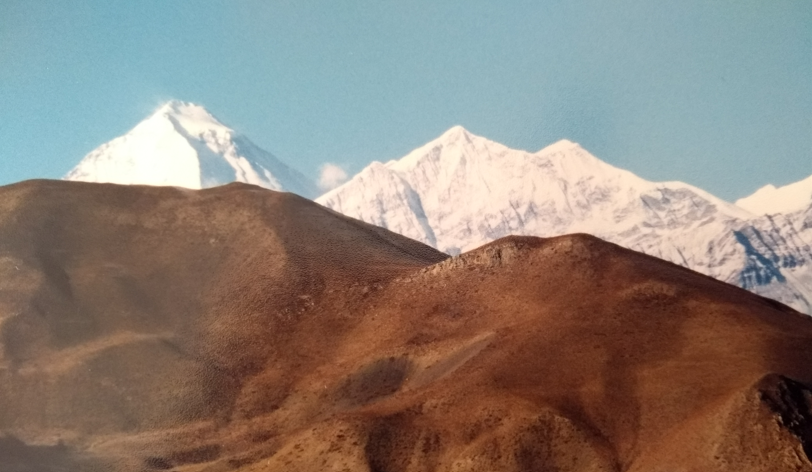
13th November: Muktinath (3,762m) – Marpha (2,665m)
‘How much rakshi did you get through last night?’
Narayan stood there grinning and trying, unsuccessfully, to look innocent as I paid the bill for our night’s board and accommodation. Not surprisingly, he admitted to feeling a bit naramro (unwell). Long after we three had retired, our guide/porter had sat round with the locals singing folk songs and guzzling fire-water.
In the clear light of early morning, we had a spectacular view of our new mountain range when we opened our bedroom door. Dominating all was Dhalagiri, a shimmering white pyramid against a steely blue sky. We crossed partly frozen streams as we left Muktinath village and followed a perfect dust path high above a broad valley. The landscape of this Mustang prefecture was incredibly arid with not a tree nor a patch of green in sight. Three colours assumed dominance: the harsh blue of the sky, the white snow of the peaks, and the variegated fawns of the bare rock faces. It was dramatic and exotic and I loved it.
We had five days’ walking to go until Pokhara and I was determined to enjoy every minute of it. Although I longed for a hot shower, I did not know when I would next be able to tramp, free and dirty, through ever changing panoramas of mountains and valleys. For the present, this was the life!
Today we planned to reach Jomsom by lunchtime and move on to Marpha for the night. Far below us was a cluster of flat brown and grey rooves: the very medieval looking village of Kagbeni, Narayan and the Lonely Planet guide informed us. Did we want a slight detour to visit it? Of course we did. We followed a steep downhill path which did my knee no good at all and stopped for tea in the village. Narayan offered Eugene a sip of his tea. Eugene accepted it and gagged. It was Tibetan style tea made with rancid yak butter. I respectfully declined having had the misfortune to have tasted a mouthful of the foul stuff in a Tibetan region of China last year.
We left the tea house to find that a dreadful wind had sprung up. People heading in the opposite direction along the valley had scarves wound tightly round their noses and mouths. Oh oh! This could only mean lots of blowing dust. We hastened to follow their example but I discovered that I had left my bandana in my backpack, inaccessible unless I unpacked the whole thing. In that biting wind the temperature dropped rapidly. I had been walking in a T-shirt at 10.00am but now, at 11.00am, I dug out my fleece and Gortex jacket. Beth and Eugene walked ahead. Narayan and I fought against the wind with our smaller bulk. The worst part was crossing a seemingly endless dry river bed. The wind whipped up a terrific dust storm. It tugged at our clothes and hair, creating hopeless tangles in mine. It filled our eyes, mouths and nostrils with cloying black dust. Beth and I were not happy, especially Beth, who was wearing contact lenses. She was soon in agony and had to stop and use Narayan as a windshield while she fished them out. I have never known such a fierce wind as that which whistles daily up the Kali Gandaki valley between 11.00am and early evening. It turned what had been a pleasant walk into an ordeal. Beth and I agreed, though Eugene begged to differ, that struggling across those miles of dusty river bed was infinitely worse than climbing up to the pass.
We eventually arrived in Jomsom (nicknamed ‘the Windy City’) all suffering from wind exhaustion and felt glad that we had decided to overnight in Marpha. It was bleak, desolate and dusty and the flat-rooved houses looked thrown together round the airfield – the reason for Jomsom’s existence. This is the first space for miles low and flat enough for small planes to land and take off, enabling emergency evacuations and opening up the higher places for time-poor tourists. Even so, the daily plane to Pokhara has to leave early in the morning before the high winds make it impossible. We trooped straight through town to the police station to show our trekking permits and sign the official visitors’ book. We had not met anyone we knew yet this morning, so I checked the book and found Claire and Chris, a couple from way back, and Paul and Irena had signed on their way through, but as yet, no-one who had crossed Thorong La with us. The gang from the ‘Wild West’ Hotel must have had a lie in. I turned around and Beth and Eugene burst out laughing.
‘God. Am I as filthy as that? Beth asked Eugene.
She wasn’t – quite, The others were bad enough but I took the biscuit. I put this down to having just covered myself in sun-block before the wind started. You could only see my eyes through the layer of congealed black dust.
We passed a German bakery and leered longingly through the glass at brown bread and apple strudel. However, Narayan assured us that he knew a good restaurant for lunch. Great! I was starving. Yet doubts grew as we moved on and away from the main restaurant zone.
‘I simply can’t go any further without eating,’ declared Eugene. ‘I sure hope this good restaurant Narayan knows isn’t in some little village half way to Marpha.’
‘Well I hope that it’s not a really authentic little Nepali place that serves only bloody dhal baht’ I voiced my own worries. ‘Not after passing all that German bread and apple cake.’ Our doubts were all wasted as, true to form, Narayan led us to the best restaurant in town, which happened to be right at the far end. It was the poshest establishment we had patronised for ages with real table cloths and China plates instead of the usual tin things. We were eating veggie chow mein and drinking delicious freshly squeezed apple juice when a girl I recognised came in. It took me a moment to place her: Terry the girl I had queued with outside the shower in Manang.
We had seen a signpost for Royal Nepal Airlines just outside, so Eugene went off to try to get a refund for his Jomsom-Pokhara ticket. He returned with a large slab of chocolate cake. We were too polite to eat this in the restaurant but fell on it like wolves as soon as we stepped through the door. We had been fantasising about such goodies on those lentil and spud filled days at high altitude. We were standing in the middle of the road gnawing it when we heard running footsteps and familiar voices. It was Rob and Clare.
‘Hi. Glad we’ve caught up with you. We’ve decided to move on to Marpha tonight too. We don’t think much of this place and besides, that’s where Steve and the Exodus gang will be staying. There are supposed to be lots of good big guest houses there so we thought we might be able to have an evening together.’
Great! We had not lost our travelling companions after all. The horrid wind stayed with us all the way to Marpha. The sky had clouded over and it was cold and unpleasant. It had been a long walk from Muktinath, further than we usually went in one day, though easy enough apart from the wind. We were all feeling a little tired and achy by 4pm and stopped to ask a man coming in the opposite direction how far it was to Marpha.
‘Kati ganda lata Marpha?’
‘One and a half hour.’
We groaned in dismayed disbelief. It felt as if we had been walking forever. We were cold and covered in dust. Another hour and a half was much too far. Luckily, we arrived at the first outpost of Marpha after only twenty minutes or so.
Welcome to Kali Gandaki Guest House announced the usual crudely painted sign in uneven red scrawl. However, instead of the usual boring old menu beneath, this place boasted Chinese, Japanese, Indian, Italian, French and German cuisine. It seemed that the Kali Gandaki valley was going to be more civilised and touristy than the Marsyandi valley which forms the first half of the Annapurna Circuit. Good. At this stage of the trek, this was just what we needed. Marpha proper proved to be the prettiest village that I saw in the whole of Nepal. It was huddled in a narrow cleft between two mountains with walled labyrinthine streets to protect it from the harsh daily winds. What a welcome respite when we entered the white stoned cocoon of its narrow streets. These were attractively paved and drained by stone covered ditches. The guest houses looked solidly built and well maintained, their shutters painted blue and green. In fact, it was the cleanest place I saw in Nepal. The Thakali people who inhabit this region have a reputation as great hoteliers and cooks and provide some of the best food and accommodation on the trail. After roughing it for so long we thought we deserved a little pampering. We checked into the comparatively plush Dhalagiri Lodge, where all hell soon broke loose. I think we should have charged the proprietors for all the entertainment we provided.
Narayan led the way up several short flights of stairs and through an attractive dining area to our allotted bedroom. We three instantly collapsed groaning onto each of the three narrow wooden beds.
‘You want massage? Asked Narayan from the doorway.
‘Ooh, yes please,’ sighed Beth
There followed a long series of oohs, aaahs and orgiastic noises as Beth signed and moaned, then shrieked if Narayan hit a nerve wrong. Eugene and I sat on our beds laughing until the tears ran, adding sound effects for good measure.
‘Ooh, Narayan…. Yes…. Yes!!’
The large gathering of German and Canadian trekkers sitting innocently eating their dinner just beyond the thin hardboard walls must have thought that there was an orgy going on. To crown it all, Narayan walked out ten minutes later with a grin three miles wide.
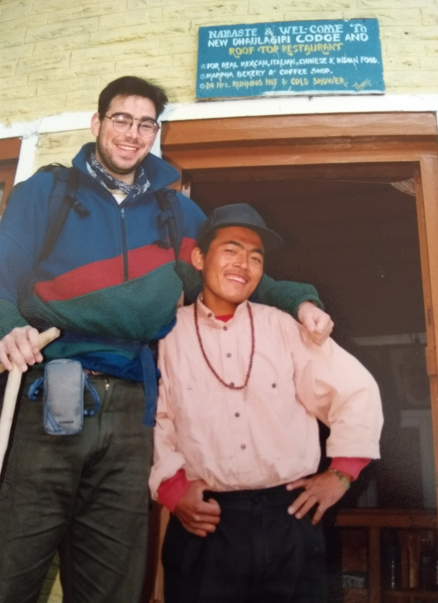
all hell broke loose
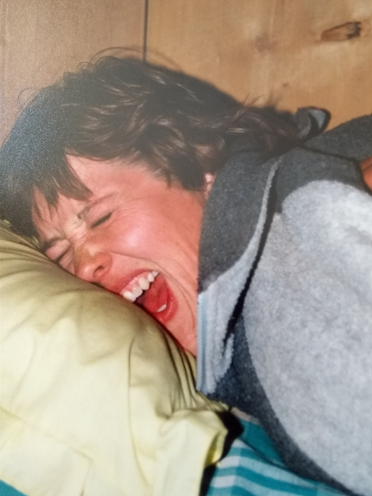
We all felt too weakened by laughter to do anything for some time after until Eugene gently reminded me that if I wanted first shower, I had better go now to give time for us all to get washed before dinner. I obediently sprang up and peeled off my dusty trousers, forgetting that I was right in front of the open door. Poor diners!
‘I said go and have a shower soon,’ cried Eugene. ‘Not strip on the spot. Honestly! The other trekkers will think we’re running a brothel.
My shower started luke-warm and finished cold, but it was a very civilised shower room with a real shower head, towel rail, tiled floor and even a mirror. I burst out laughing when I looked into this – my first glimpse of my ugly mug since Manang. I could not tell if my face was tanned yet as it was so thickly coated with grime and my hair was a bushy reddish tangle, matted with dust and sweat. I had to shower, cold water or not.
Dinner was wonderful. It was fun to meet a new crowd around the dining table. There were three German guys who had zipped around the Annapurna Circuit in nine days, and a laid-back American couple who were on their twenty-first day. We three were currently on Day 12 which we judged a happy medium. We also got talking to a really lovely Canadian couple, Sonia and Paul. I recognised Paul as the guy we had greeted outside the temple complex in Muktinath yesterday. They were both English teachers working in Taiwan, Sonia’s mother’s country of origin. They had only three weeks’ holiday and wanted to do other things in Nepal besides trekking, so they had flown up to Jomsom from Kathmandu and were doing the Jomsom trek in reverse, walking down the Kali Gandaki valley. So while Eugene, Beth and I were revelling in the soup-thick air at just below 3,000m, they, unacclimatised, were feeling breathless.
More and more delicious looking things arrived at our table prompting remarks such as:
‘What’s that? I should have ordered that.’
Sonia’s dessert arrived: a bowl of steaming chocolaty stuff with chopped nuts on top. Eight tongues simultaneously hit the table.
‘Though shallt not covet thy neighbour’s dessert,’ I reminded everyone.
I had Mexican burrito which was, basically, a chapati stuffed with spicy cheese and beans. It was the tastiest meal I had had for many a day. Eugene had pizza with loads of toppings piled on it and even Beth was tempted to forego her usual boiled water in favour of lasagne. Narayan stuck to his dhal baht.
Somehow we ended up starting a Nepali revision class, repeating to Narayan all the various words and expressions we had learnt over the twelve days of our trek, though not in any particular order or context.
‘Miro nam umleko pani ho,’ announced Beth, while Sonia and Paul gawked in amazement.
‘Wow. That sounds pretty impressive. What does it mean?’
Eugene and I stifled our giggles as we dispelled the myth. ‘My name is boiling water,’ I translated.