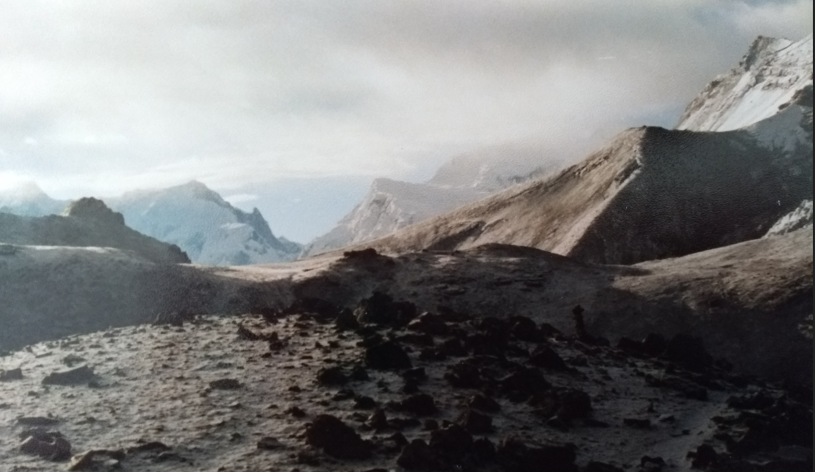
12th November: Throng Phedi (4,440m) – Thorong La (5,416m) – Muktinath (3,762m)
The Big Day.
3.30am at last.
I was lying awake when the alarm beeped. Inside our sleeping bags was certainly the only warm place in Thorong Phedi, but rise we must. An early start was the only way to ensure that we crossed the pass before the wind sprang up. As we were rolling our fluffy sleeping bags into stuff sacks in the slow motion brought on by the ungodly hour and cold, Narayan came banging on the door.
‘Hello. Wake up,’ he called with a chirpiness that would have been irritating had I not loved him so dearly.
Narayan once again proved his worth by securing us an early breakfast. We were joined by Clare and Rob in the dining room. Full of hot tea, noodle soup and porridge, we set off upwards into the darkness. We were among the first of a silent torchlit procession. Plod, plod, plod. We puffed up the mountain in single file; Eugene storming away in the lead, Shandra, Narayan, then me, with Clare and Rob just behind and Beth, slow and sure, as rear guard. It was too high, too steep and too cold for much conversation. The only sounds were of our plodding steps and huffing and puffing. Clare, Rob and I complained from time to time of frozen hands and feet. The track was difficult to spot in the dark so we were very glad to have Narayan’s experienced lead. To go wrong would have meant more painful, breathless steps to rectify our direction.
What a feeling of achievement when we reached the summit of the first false peak. We paused in a group for breath and to look back to where we had come from. Below us, I could see a long line of torch beams creeping slowly upwards. It made me think of Close Encounters of the Third Kind as we sat listening to the deep silence of the mountains. These lights were not sinister or ghostly in the least. They appeared friendly even from a distance and proved to be wielded by the Exodus Mob. John and Steve arrived at our peak ahead of the others and stopped to exchange thoughts on the going so far.
Dawn rose as we approached the next false peak, shading the receding mountain slopes in a luminous pearly grey. Mercifully, the path was a little less steep now. We halted again to take it all in and Eugene braved the elements and took off his gloves to take a photo. I fumbled with frozen fingers to get at my camera too. My hands were warming a little but my feet were still bitter.
‘Shut up about your feet,’ growled Beth. ‘You keep reminding me of how cold mine are.’
Patches of thin snow stood out against the grey rock faces all around. From our elevated point, the peaks surrounding us did not look so high. It seemed strange to look downwards at the views rather than up. Just ahead was a tiny isolated mountain hut. It turned out this was run by a local entrepreneur with ambitions to turn it into a hotel. Good luck to him, I thought. As yet, there was no running water and he had to limit himself to serving tea to cold and weary climbers. God knows where he got the water from – melted snow? Heaven forbid that he should stagger up here with bottles of mineral water every day. We were all certainly grateful for his presence.
‘Now we about one hour from top,’ Narayan informed us.
This information was received with all round incredulous delight. We were making much better progress than we had ever dared to hope. Clare and I were desperate for a pee and risked frostbitten bums, peeling off layers in a mad dash to the comparative shelter of a bank of rock. There was no convenient tree to offer concealment way up here.
Someone remarked that it was amazing that we were all breathing so effortlessly at such a great height. We were probably standing at around 5,000m above sea level right now. It was true. We could all talk and laugh quite normally at rest so we must have acclimatised well. However, the final 400m or so were more telling. Soon after leaving the hut, moving upwards even on the mildest of gradients felt like a great effort. I found myself having to stop for breath every few minutes, then finally, every few metres as we neared the top of the pass. That last little bit seemed an extraordinarily long way. There was a surreal quality to it all. Two older members of the Exodus Mob came past with a kind of glazed look, swaying and staggering a little. Eugene wondered aloud if one of them might be suffering from ataxia (difficulty walking in a straight line due to dizziness brought on by altitude). They would be heading downwards so soon now for this not to greatly matter. There was none of the usual banter and sharing of anecdotes among the trekkers and no burst of Resum Piriri. We were all concentrating on the supreme effort of putting one foot in front of another, assuring ourselves that each one would bring us closer to our goal.
Oh joy! Finally we spotted a row of multi coloured prayer flags fluttering around a mound of stones: the chorten that marked Thorong La, the pass of our dreams and dreads of the past days. I smiled to myself as I paused, yet again, to catch my breath and looked up to see Eugene, Rob and Clare beckoning from a rise.
‘Come on Sara.’
I felt incredibly elated as I staggered on upwards for the last few metres to join them.
‘Whoeeeeeeee!’ I cried, as I put that last foot forwards. ‘I’m exhausted. I’m freezing. But I’ve done it!’
The others reached forward and we all hugged each other and jumped around with the renewed energy that only a great sense of mission accomplished can give. Beth appeared around a rock at the level of the chorten.
‘Come on Beth. You’re nearly there.’
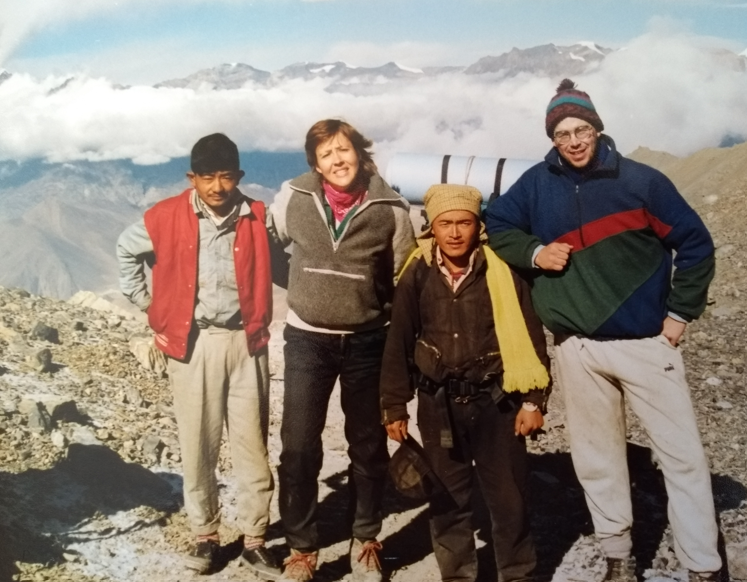
Narayan was following close behind and Steve, Rob and Clare’s friend from Exodus, was already on top with the others. There we all were on an all time high. Thorong La: 5,416m above sea level, 600m higher than Mt Blanc, the highest point in Europe and, quite possibly, the highest point on earth that we would ever reach. We deserved to feel proud of ourselves. With the whole team assembled, we risked exposure and frostbite while we stood around and posed, removing gloves to take a series of team pics. They had better come out!
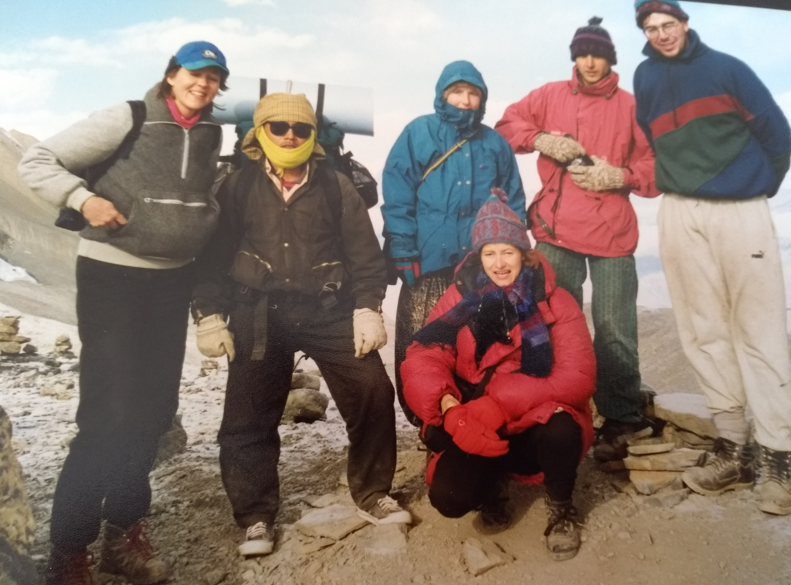
‘I’m going,’ asserted Steve, chief guest photographer, pulling his gloves back on and careening off down the mountain before he could be commandeered to take any more.
Beth insisted that having come all this way, she wanted to stay round to enjoy the scenery, so she and Eugene made us all pose in front of the prayer flags. They both commenced a whole series of ‘I was here’ photos (and this was long before the days of mobiles, Facebook, Instagram and selfies). Rob, Clare and I decided it was far too cold to stay at the summit for a moment longer and took off downhill at a remarkable rate towards relative warmth and civilisation.
Down, down, down we rushed and feeling gradually crept back into my fingers and toes. Clare and I had to brave another dash behind a convenient rock. She and Rob then carried on down while I stopped for water and biscuits with Shandra, who had gone on ahead with the packs. I had caught up with him just after the wee stop. We must have waited for about ten minutes in the most utter quiet I have ever known. You can almost always hear some sound at lower altitudes: the whirring of insects, birdsong, but here among the snow-capped wilderness at the top of our planet, there was nothing.
A new range of mountains hovered amongst a barrier of wispy cloud ahead. No other trekkers passed and I began to wonder if we had gone the wrong way. But there was only one track. Then finally, I spotted three familiar figures in the distance and caught the strains of Resum Piriri breaking the silence.
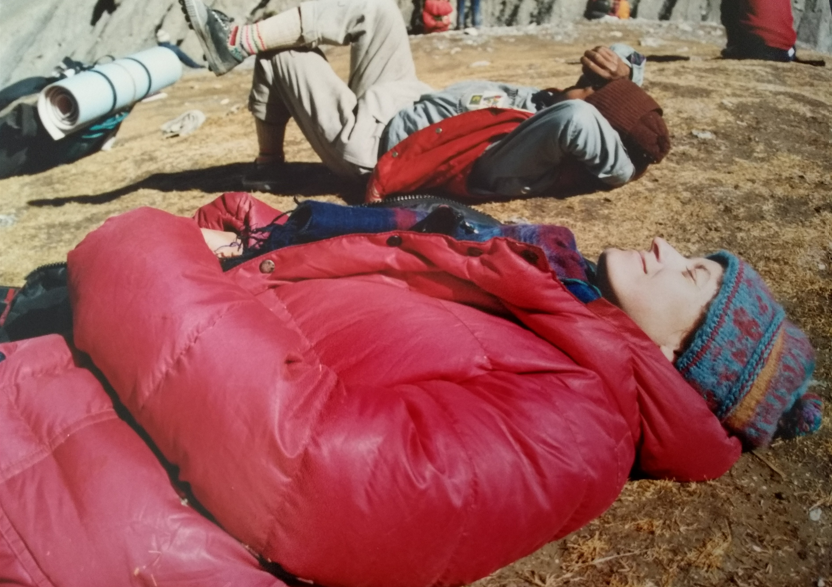
Waxing lyrical about the beauty of the mountains, we continued on down until we came to a grassy meadow at C. 5,000m where we found young Steve crashed out with several companions from Exodus and a bloke called Norman who we had seen from time to time. The short grass looked soft and tempting so we joined them and sprawled down on it, enjoying a rest and the view of the arid mountains of Mustang ahead in the distance. While we lay there, it seemed that practically everyone we knew from the trek so far gradually turned up to join us for a bit of welcome slothfulness. First Patrick turned up in his bright green fleece pockmarked with escapee feathers from his down jacket.
‘Hello Patrick. Would you like a chocolate éclair? I asked, having fished in my pack for a few squashed celebratory sweet treats.
As we sucked on our toffees, Peter and Paul flopped down next to us, Peter glibly announcing, ‘Piece of piss, wasn’t it? And I was shit scared all that time. We should never have listened to that bloody doctor in Manang.’
They were followed closely by John and Alison, Grace and Ken, Exodus John and Steve and Gudrun and Gerard, all in quick succession. Brilliant! Imagine the sense of camaraderie as we all lay flaked out on that high grassy plateau, feeling blasé now the hard part was over. Many photographic mementoes were taken by all. Peter and Paul posed in wonderfully silly multi-coloured jesters’ hats. Then we all delved into our respective day-packs to retrieve all the various bits of chocolate we’d been hoarding: mangled mini Mars Bars, squashed snickers and pulverised Indian versions of Dairy Milk were all relished with great abandon. From now on, we would be heading back towards civilisation and could afford to binge on all our emergency supplies.
Then it was onwards and downwards on the longest, steepest descent I have ever known. To my great amazement, I had actually enjoyed the climb to Thorong La. The sense of exhilaration had kept me going to the extent that when nearing the top, I was actually muttering to all the world’s gods: ‘Thank you for giving me the opportunity and physical fitness to see all this. However, I always find steep descents far harder than ascents because of my dodgy right knee. Back in 1990, when I was living in Barcelona, my British Council colleagues and I would cram onto buses to Andora on winter Friday nights to enjoy cheap no frills skiing weekends. On one such weekend, I was whizzing happily down a piste when a Catalan girl cannoned into me from behind. As she was much bigger and heavier than me, I came off worst in the crash. My ski binding did not release and my right knee twisted painfully. With the help of friends, I managed to limp down the rest of the mountain, but my ligaments were strained. I limped around Barcelona for several weeks. After that, I could walk normally, but my injury would always flare up on long steep descents for a good 10 years after the ski crash.
Now, the endless sharp downward spirals soon had it twinging painfully. I was forced to shuffle down sideways to minimise the strain. At my consequent snail’s pace, everyone soon overtook me and I was left virtually alone on the mountainside. Faithful Narayan was the only one who noticed and stayed behind to ensure I didn’t collapse in a heap and he tried to help me down the steepest bits. Actually, it would have been easier to find my own way down in my own time, but I really appreciated his concern and friendship.
After what felt like an eternity, we arrived at the bottom and found all the others sitting drinking tea outside the first café we had seen for miles. It was hard to find the energy and motivation to move on after that tea stop but at least the final hour to Muktinath was along far easier trails across meadows. On the flat the pain in my knee eased considerably. Best of all, when we came to the odd steep path up a cliff, I was able to leap up it like a mountain goat. We were at around 4,000m and I marvelled at how, several days ago, I had barely been able to puff my way up such an incline. All those extra red blood cells I’d been manufacturing in the oxygen depleted air had done their job well and I felt as fit as a trained athlete. I wondered how long they would last. Knowing sod’s law, they would probably have petered out by the time we reached the long climb at Ghoropani several days hence.
Muktinath, in the valley ahead, looked like something out of a National Geographic shot. The flat rooves were a similar grey/brown to the surrounding landscape. It was arid, treeless and exotic, far more reminiscent of Tibet than the wetter more wooded western slopes we had just crossed.
Eugene was ahead walking with Exodus John. Beth and I were behind with Narayan and Shandra, enjoying strolling across this flatter section and pausing to take in this new type of scenery. We passed the twin holy shrines at the edge of ‘town’ one Buddhist, the other Hindu. We met a girl from New Zealand coming out of the shrines’ shared grounds.
‘It’s wonderful,’ she told us enthusiastically. ‘You really must go in and see them both. It’s a really uplifting experience.’
Beth wondered if we should go in now while we were passing rather than having to tackle the numerous uphill steps back from the village centre later that afternoon. However, I cautioned that Eugene might murder us or, at the least, throw a sulk, if we had such an uplifting experience without him. Beth hastily agreed. Anyway, we were both starving.
It was 13.30 when we finally passed the mani wall and chortens of Muktinath village, far earlier than we had imagined. We had made the crossing of Thorong La in very respectable time and Narayan admitted that we had been very lucky with the weather conditions. We plodded along the main street congratulating each other on making it this far. It was downhill (nearly) all the way from now on. We passed a wooden hotel that resembled something from the old Wild West and Rob and Clare leaned over the balcony to shout
‘Hi. Everyone’s up here.’
We swung through the half timbered door and came face to face with Paul in a towel saying: ‘You’ll never guess what the main complaint is here. The water in the shower is too hot.’
Eugene was hanging around talking to the others and after that gem of information, we three were dying to dig in there. However, Narayan poo pooed at the state of the rough, dirty earth floors and characteristically led us on to somewhere more in keeping with his exacting standards at the far end of the village.
“The Muktinath Hilton” (at least that’s what it felt like in comparison to the basic establishments we had patronised of late) gave us a room with a glass window and a linoleum floor. We were the only guests and this, Eugene pointed out, was a real bonus since the queue of hungry trekkers for food and the too hot showers was probably astronomical at the Wild West place. Feeling suddenly knackered, our party of five (including Narayan and Shandra) collapsed onto cloth covered benches around a wooden table which, joy of joys, turned out to have a deliciously warm coal heater under it. I had spent the past few days being mostly somewhere between mildly cold and frozen stiff so it was a real luxury to thaw out properly. I don’t know the exact temperatures we had suffered recently but we had started out that morning with flasks of freshly boiled water and only half way up to the pass, Clare’s, in a metal bottle, was frozen solid. The chicken soup and wild mushroom pizza I ordered for a late lunch was an equally welcome surprise after boring dhal bhat and fried spuds. Had we arrived in Muktinath directly from the West, we would probably have been horror struck at how far we were into the back of beyond, but after the likes of Letdar, this place positively oozed decadence and luxury.
Eugene and Beth declared themselves exhausted and drooped off to the bedroom. I stayed at the table for a while to write my diary and revel in the sense of the comfortably exotic that my surroundings gave. I had just successfully negotiated a 5,416m mountain pass and here I was, replete, muscles stiff, but feeling strong, watching Narayan and Shandra crack open a couple of beers to wash down their dhal bhat and two Tibetan featured women picking god knows what out of each other’s hair in a shaft of sunlight streaming through the open door.
It was even warm enough to take one’s clothes off briefly in the middle of the day in Muktinath so I managed a bucket shower and luxuriated in feeling less repulsive than I had done for days. I stood in a small, stone bathroom and stripped quickly before the bucket of precious hot water had the chance to cool. I dipped in the scoop and threw water over my matted head. I am quite expert at washing efficiently: ladle over head, shampoo, ladle over body, soap, remainder of bucket tipped over the lot, but save one scoop to rinse underwear.
I draped my by now very mucky towel over the line outside and combed my wet hair as I went back to our room. Eugene and Beth were clapped out on their beds still in all their clothes save for their boots. Their feet were minging!
‘You should go and get a shower you smelly people,’ I said, with the righteousness of the newly cleansed.
‘Naa,’ a series of groans came back.
‘Who wants to be clean?’
‘We like being dirty?’
‘I’m not planning on getting clean till I get back to the U. S. of A.’
They both borrowed my shampoo and soap later that evening.
Meanwhile, we had to say goodbye to Shandra. While I was in the dining room, Narayan had unexpectedly announced that Shandra would be leaving for Jomsom, a town further down the valley, almost immediately since there was a good chance of picking up another load there. Men like him seem to live like nomadic pack animals, moving up and down the valleys wherever there is a chance of work. Beth paid him the previously agreed sum of money and, after some deliberation, added a disproportionately large sum as a tip, justifying this by saying that it worked out a lot cheaper than knee surgery.
After the fond farewells, the rest of us set off to see the famous Muktinath temple complex. First we staggered up the steps to the Vishnu temple where we were greeted by a Hindu priest and each marked with a tikka of red powder on the forehead. Non-Hindus were not allowed in the inner temple but the priest gave us a good potted version of its history. I had heard that wandering penitents, or sadhus, came here from all over the Indian sub-continent and I had hoped to catch sight of some, but apparently it was not pilgrimage season. Beth remarked that it suddenly looked very autumnal. In the lowering light of the late afternoon, the trees stood out as skeletal frames against a pale, cold sky. A few sad leaves still clung to the branches.
We moved on next door to the Buddhist gompa. I felt the yellow ribbon, damp from my recent shower, still round my neck. It had served me well since Manang. Plebby Patrick had complained that he would not be able to take it off until he was safely over the pass. Our team, on the other hand viewed our yellow ribbons not as an encumbrance but as a proud symbol of all that our trek stood for and wore them with pride until they literally fell off days later. To remove them before the end of the trek would be asking for trouble.
Narayan, an ethnic Tamang and a devout Buddhist, knew the format here. He led us past a huge amphitheatre of fountains. Each was carved with a demonic head with water spouting from the mouth. We took Narayan’s lead, smearing the holy water across our foreheads. My hands were numb with cold again by the time we reached the last fountain. Now cleansed, we could proceed into the temple through the ritual of prayer wheel spinning. A woman waved to us, indicating that we should remove our shoes and we bent down stiffly to oblige. The temple was the usual menagerie of fearsome-faced demons and colourful brocade flags. What distinguished it from thousands of other temples and gave it super-holy status, was the occurrence of natural gas which oozed from the altar rock creating an eternal flame.
We laughed together as we jostled down the temple steps, attracting the attention of a young blond man sitting on a bench. He smiled and said ‘hi’ as we passed the exit. My knee hurt again as our overused limbs creaked down the steps. Narayan scooped me up to give me a piggy back while the others cheered and I shrieked with laughter until I felt sorry for him and leapt off.
We caught sight of a scruffy little kiosk displaying (wonder of wonders!) Pringles crisps and made a slavering detour to purchase some. The kiosk also stocked postcards of Thorong La looking impressively difficult and snowbound. As we passed the ‘Wild West’ guest house, I spotted Clare and Rob through the window. As we were planning to push on beyond the next official stage end point of Jomsom tomorrow and reach Marpha in an effort to avoid the crowds, this might be our last chance to exchange addresses. So the others went on and I pushed through the saloon door. It was cold in the dining room and I felt glad that we had agreed to Narayan’s choice of accommodation. Clare, Rob and I all wrote our addresses down on scrappy bits of paper and promised to contact each other when Clare and Rob returned to Britain at the end of their travels next July. It felt sad to be saying goodbye to partners in such an adventure. We felt we had come a long way together, both literally and figuratively.
Dusk was falling as I made my way back through the village. I jumped aside to avoid a couple of cows crossing the road. Tibetan women called to me from a stall selling trinkets and bright woven shawls. How strange it felt to be back in the realms of tourism. And how welcome!
‘What is the problem? You not like?’ came disappointed cries as I bypassed the stall.
I smiled. ‘Your things are lovely, but I don’t want to carry them all the way to Pokhara.’
Back at base, I found another minor miracle. Beth was taking a bath and Eugene was wrapped in a towel ready for the same. By the time they had finished and Eugene had even put on some deodorant, our room actually smelt quite nice. I went off first to the dining room where I joined Narayan, our hosts and several villagers sitting around the warm table drinking foul smelling local brandy. A radio with failing batteries was playing excruciating English pop music.
‘It must huv bin lurve…..but it’s o overrr, now a ow,’ it droned and I couldn’t control a sudden fit of giggles. Luckily, the hosts changed both music and batteries and a burst of a Nepali folk song that the kids had sung on Dipwali night so long ago in Bahundanda, issued forth. Eugene burst into the room and joined in the singing.
Now we had to talk business. When we originally hired Narayan, it had been on the understanding that he would carry packs for both Eugene and me as far as Jomsom, from whence Eugene would take the plane to Pokhara, leaving Narayan to saunter along carrying my measly 10kg on as far as Pokhara. However, as we had made good trekking time so far and had taken none of the built in sick or bad weather days we’d budgeted, we were far enough ahead of schedule for Eugene to walk from Jomsom to Pokhara if we pushed a bit. Eugene was enjoying himself so much that he had no intention of taking a boring old plane when he could commit himself to several days more muscle ache with Beth and me. Narayan, however, was a little piqued at the prospect of carrying 23kg again instead of ten.
‘But you only had to carry ten kilos for the last few days while we had Shandra,’ argued Beth.
‘But, I not carry before. I usually cook,’ protested Narayan, looking wounded. ‘I get very tired.’
‘I think I have a solution,’ said Eugene with a flash of good-willed inspiration. ‘I’m much fitter now than when we started and now we’re over the difficult bit and I’m acclimatised, I could carry my own pack and you can just carry Sara’s Narayan.’
Beth and I must have looked agog for a moment before Beth said that if she could carry sixteen kilos for three weeks, then surely a great hulk like Eugene could manage thirteen for four days. In the end, Narayan agreed to take Eugene’s slightly heavier pack while Eugene carried mine. I, being the 41kg weakling of the group, would be left carrying my day-pack, but we evened things out a little by adding Eugene’s camera and what remained of the food to that. We all shook hands on it.
Oh, what bliss it was to get a decent night’s sleep. The air felt positively thick down here at a mere 3,762m with all that extra haemoglobin coursing through my bloodstream. Higher up and when we had been acclimatising, one of the effects of thin air had been irregular breathing while sleeping. This meant Eugene lying hyperventilating like mad and then stopping breathing for up to half a minute. It’s a bit disquieting to lie in your sleeping bag hearing nothing from the next bed.
‘Eugene, are you dead?’
Then, at last a heavy, snorting breath. Relief. I would not have to organise removal of a body down a mountain after all.’
Have you crossed Thorong La? I would like to hear about your experiences. I have heard that there is now a road virtually all the way to Manang so hiking the Annapurna Circuit is probably very different today than it was in 1994.