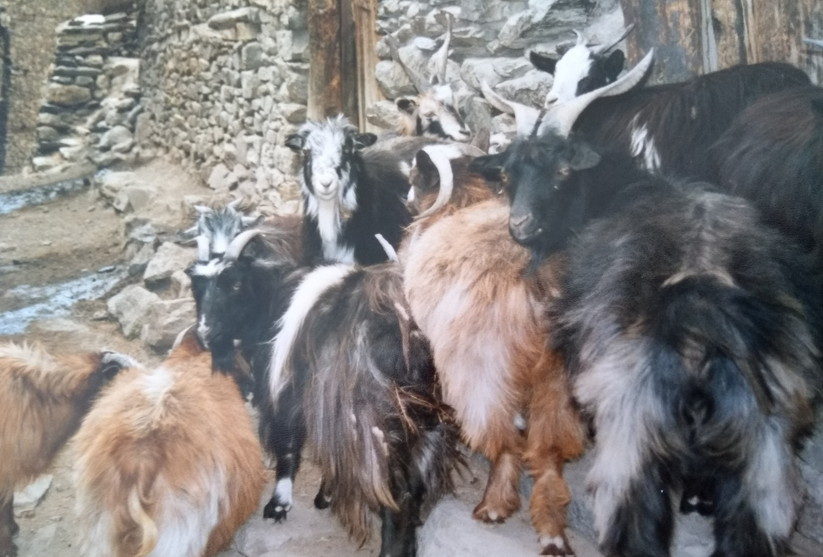
10th November: Manang (3,535m) – Letdar (4,176m)
Somehow, we had been led to believe that this was a short leg. I’d heard rumours of 6km flying around. I don’t know if this was correct but steep tracks at high altitude don’t make for easy walking and it certainly felt a lot further than that. Anyway, today’s walk took nearly five hours instead of the anticipated two and a half. Actually, this was no bad thing. Early arrivals only mean sitting around in the cold rather than keeping warm walking. Other trekkers seem to move faster than Beth, Eugene and me, so we were lucky to have Narayan and the new porter who raced ahead to Letdar to secure us a teahouse room.
Yes, we now have an additional team member. Beth, encouraged by Irena, had decided to take on a porter in Manang to carry her backpack as far as Muktinath (i.e. over the worst bit when she was likely to get even more out of breath than usual). Narayan had put yet another of his many talents into action – networking – asking around in Manang until he had found Shandra for her.
Shandra is practically smaller even than Narayan. He’s thirty odd but looks older and doesn’t speak much English. He makes up for his lack of verbal communication with a plethora of friendly smiles. He’s a native of these high parts so better used to life at altitude than Narayan. He’s therefore been assigned to carry my pack as well as Beth’s, while Narayan shoulders just Eugene’s. A lighter load has broadened his grin still further.
We started out from the Yak Hotel in clear-skied sunlight and followed the trail through Manang village past locals washing in barely thawed streams. Brrr! We climbed upwards across a steeply sloping field. I mentally reassured myself that shortness of breath on steep ascents at over 3,500m was to be expected. I was walking easily and confidently on flat and downhill stretches with no sign of headaches, nausea, or any of the other symptoms of altitude sickness. Eugene tended to race ahead, I would walk in the middle, with Beth, who was even slower than me, bringing up the rear. I was working at imitating Narayan’s trekking gait: very slow and steady but never quite stopping. It is easy on the muscles and the lungs and you never get out of breath enough to have to stop altogether.
I bought a walking stick from a boy at the end of Manang village and lost it at a water stop about ten minutes later. There are very few trees up here but a lot of colourful red-leafed undergrowth. The sky becomes a more intense blue the further up you go as the atmospheric oxygen does not interfere with its hue. Against the brilliant blue, the mountain peaks loom in many shades of brown, grey and white. We all felt ridiculously happy. After a tea stop in the sun, Narayan struck up one of his lilting and catchy trademark Nepali songs. Eugene broke into a spontaneous Irish jig but at C.4,000m, soon decided that this was unnecessary exertion.
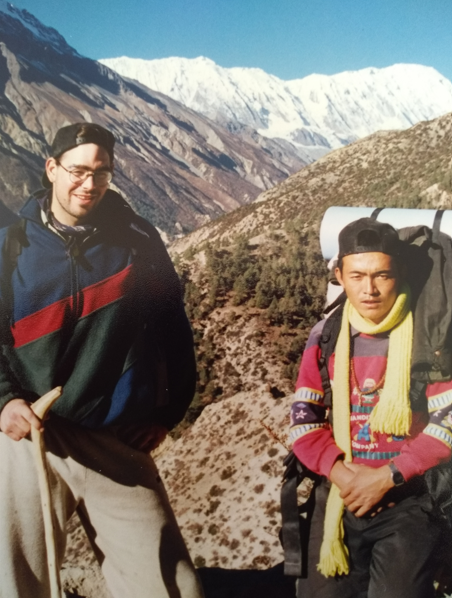
Soon after the tea stop, Narayan and Shandra decided to go ahead, leaving Beth, Eugene and me to enjoy the walk at an enviably leisurely pace, free of accommodation worries. We figured that the slower we went, the longer that would give us to acclimatise gradually to the altitude, so we had many water stops, commensurate pee stops, photo stops or simply ‘relax and enjoy the grandeur all around’ stops. During one of the later Clare and Rob popped over a rise and joined us to crunch on granola and pour yet more water down our collective gullets. You don’t get so noticeably thirsty when it’s cold but can get dehydrated quickly when climbing and we were all concerned about keeping up our fluid intake. We walked on with Claire and Rob for a while. They seemed an enviably perfect couple. Both in their mid-twenties, they had taken a year out to travel the world. Despite an impressive list of frights and catastrophes, they were still together and seemed to get on remarkably well, supporting each other through thick and thin. The same cannot be said of all the couples we encountered. Travelling can either make or break a relationship.
Clare and Rob had travelled around the constantly chaotic zones of sub-Saharan Africa before crossing the ocean to India. It was there that the ‘fun’ really started. They had been sitting on the Bombay to Delhi train a few weeks back when the headlines of a newspaper being read by the man opposite had jumped out and hit Clare with an alarming punch.
PLAGUE HITS INDIA
They asked to borrow the newspaper.
‘Surat? Where’s that? Never heard of it’, said Rob in an attempt to calm Clare. ‘It’s probably on the other side of India.’
They looked it up on the map and found that it was the next stop.
‘Don’t worry’ the man sitting opposite reassured them. ‘The train won’t stop in Surat. It’s a contagious area and will have been cordoned off. Our train will go straight through.’
But of course, as Clare enjoyed recounting, not only did the train stop in Surat but half the population tried to cram themselves on.
Clare and Rob had avoided contracting bubonic plague but their follow up was travelling through Rajasthan during an epidemic of cerebral malaria.
‘Well, I don’t know if we dare continue travelling with you two,’ I said. ‘We’ll probably end up running into some outbreak of a little-known strain of Lhasa fever in Muktinath.’
A little further on we crossed a bridge over the rocky grey bed of a river which was frozen at the edges and climbed a very steep track over a rise on the other side. While we paused to regain breath, Eugene spotted a familiar figure in a silly woollen bobble hat approaching the bridge. Gudrun marched along a good way behind with their porter and guide in tow. We waited and they all caught us up. We continued together until we came to a small guest house in the middle of nowhere. Gudrun and Gerard spotted some people they knew sitting at a table outside drinking tea, so they decided to call it a day and join them. We learnt that it was about an hour’s walk from here to Letdar. Rob and Clare decided to stay put too since they thought they were among the last of the day’s trekkers to pass and were worried that the limited accommodation in Letdar might be full. Unlike us, they had no advance scouts to send ahead.
‘See you in Thorong Phedi tomorrow’, we called and wound our weary way onwards.
The last stretch to Letdar felt much too far. I got breathless easily on the constant ascent and a chilly wind had sprung up again. I was also starving. I had spent the previous half hour fantasising with Rob and Clare, who were going on to Thailand after Nepal, about chicken satay and peanut sauce, hot and spicy tom yam soup and fish marinated in coconut gravy. The others had told me to shut up. I wondered what Letdar had to offer in the way of lunch. Could there possibly be fried potatoes and yak cheese? Or would there be good old fried rice with vegetables (please read cabbage) yet again? We plodded on over rough scrubby stuff before rejoining a flattish path towards the welcoming sight of two grey buildings a little way ahead.
We found a group of Dutch trekkers shouting at Shandra to find them a room.
‘Hey,’ cried Beth indignantly. ‘That’s my porter. Don’t yell at him. He doesn’t even work here.’
Some travellers seem to shout their demands at anyone who looks like a local, regardless of who they might be or how unrelated to the job in question.
Our room was a bare little stone box with three narrow plank beds squeezed into it. Nevertheless, it was the best available and Narayan and Shandra were heroes to have gone ahead, carrying the bulk of our luggage, to secure it. We thanked them profusely.
A crowd of acquaintances were sitting at the bench tables outside: Patrick and British John, two blonde blokes called Peter and Paul (British friends travelling together) and a tall couple called Grace and Ken whom we had met before but had not really spoken to yet. I informed John that he was in the dog house because he had run off with Alison’s precious gloves and she thought she had frostbite. John was trekking without a sleeping bag and consequently spent every night shivering beneath borrowed teahouse blankets. He had developed a nasty cough which had wracked through the walls of the Yak Hotel in Manang. I had been round to dispense cough drops and creosote flavoured catarrh pills, feeling like chief matron.
Alison arrived and, as suspected, turned out to be suffering from paranoia rather than frostbite. Ordering lunch took forever. Two confused Tibetan girls wandered in and out with a battered notebook. This was passed laboriously round the tables while everyone perused the usual boring old menu dejectedly. Since the same poor girls were cooking on a single wood fire with the most primitive of kitchen utensils, there would obviously be a long wait for food.
We sat at a bench in what remained of the sun and talked to Richard, a guy we recognised from the Yak Hotel in Manang. He had spent some days there convalescing from a flu bug but was now well enough to tackle higher places. Eugene felt cold and huddled in his down jacket. I, for once, was not too bad and my fleece sufficed as long as the sun stayed out. My food was last to arrive, as usual, and I had to gnaw on dry Nebisco biscuits while I was waiting.
By the time we had finished lunch, the sun had gone from our part of the valley and the best way, the only way, to keep warm was to walk on a bit. Bundled up in layers of clothing, Beth, Eugene and I headed on up the track towards Thorong Phedi, talking, as we so often did, about how we were all feeling and asserting, with cautious optimism, that as long as we were sensible and took it slowly, we believed we could make it across the pass. We caught up with the sun and walking was pleasant for a while but, when we lost it again, the penetrating cold of thin, high-altitude air pierced my layers and I decided to head back in the hope that someone had lit a warming fire at our base. The others continued walking for a while. Movement had thawed Eugene’s muscles and he was enjoying himself. Beth always soldiered on, slowly but surely.
I found a burst of sun again at Letdar’s second guest house, just around the corner from ours, and stopped there to chat to an American couple who were camping nearby. As usual, the conversation revolved around how we thought we would fare over Thorong La. Everyone was becoming obsessed with that bloody pass. I believe we were all secretly looking forward to the challenge but no-one dared risk admitting this. Don’t tempt fate. Anyway, the more we built it up as something scary to be conquered, the better we would feel if we emerged unscathed on the other side.
Back in our cold dark room, I thought I would sort out my sleeping gear while there was still a crack of daylight coming through the door. I had more space to do this while the others were away. It’s not easy to pack and unpack with three heavily clothed people crashing about in a confined space. As it was, I think we had become reasonably expert at it. I didn’t like to risk messing with the others’ packs to get their sleeping bags out, but I had a wash with cleansing milk and left the bottle out as a treat for Beth when she got back. I then hid round the back wall to have a pee. I had sampled the official loo earlier and concluded that it was easily the worst that I had seen in Nepal – or probably anywhere for that matter. The shit hole was overflowing with splodgy paper and nameless other substances that bore witness to the sorry state of many trekkers’ bowels. The overspill had leaked and blown across the wooden floor and the whole place reeked. I had stumbled out, gagging, and found Alison next in line. She glanced in and held her nose.
‘Did you make all that mess, Sara?’
I thumped her with a ski glove and we both giggled. Nothing would entice me to use that loo again. Al fresco would have to do. Luckily, my intestines seemed to be better behaved than most other people’s.
Back in the room, I pulled on my down jacket and was just about to lock up and head for the kitchen and a potential fire when I caught sight of my companions in the distance. I waited, my eyes fixed on the two small figures in the empty grey landscape. It had clouded over and looked like snow. I felt nervous and excited about the next two days but, for the moment, my greatest discomfort was the cold. Eugene and Beth finally arrived. I handed the key over and went to the main building.
Most of the people in the main area of the guest house were unknowns. I found ‘our crowd’ in a smaller room, huddled in their sweaters, fleece jackets, gloves and woolly hats, around a large square table. They had all hoped it might be warmer in this smaller annex. Eugene soon joined us while Beth remained fiddling about in the room as usual. The only heat was provided by a bucket of dying coals under the table. Narayan wandered in, noticed how cold it was, then bravely suffering the smoke and fumes, he crawled under the table to retrieve the bucket.
‘Hey,’ cried Alison indignantly. ‘That Nepalese guy has just nicked our coal bucket.’
Now it was my turn to be indignant. ‘He’s our guide and porter. He’s only going to fetch fresh coals for us. He’s trying to do us a favour.’
Narayan duly returned with a replenished bucket. It might have made our space under the table marginally warmer.
‘Ooh, I think I can finally feel my feet again,’ sighed Alison presently.
‘No. They’re Patrick’s’ quipped Paul, which raised a much-needed laugh from the whole assembly.
Letdar was a low point in all but altitude. It really felt like the back of beyond. The food was lousy and you had to wait forever to get served. Our normally congenial companions were cold and grouchy. Outside, it had started to sleet. Beth appeared along with Richard who complained of being bored: a rare occurrence on the Annapurna Circuit. I read out the extract of Eugene’s guidebook on the next two stages – to Thorong Phedi and beyond. We all expressed suitable reservations about the altitude gain on the day we would cross the pass and compared our real and imagined symptoms of mountain sickness. It seemed that no-one (except me) felt much like eating anything.
‘It’s not that we don’t feel hungry,’ said Peter with a strong Mancunian accent. ‘It’s just that there’s not exactly a great variety of tantalising culinary treats here, is there? Now if we could have beef bourguignon, or chicken tikka masala, or even a good old Big Mac, I’m sure we could work up an appetite. But no. What are we going to get? It’s going to be yet another bloody dhal bhat.’
Once the food finally did start to appear, folks began yelling at Narayan again as, being Nepali, he was ‘obviously’ a waiter.
‘Bring me some tomato ketchup.’
Bring me some chilli.’
‘Listen you lot,’ I intervened again. ‘Narayan is our porter, not a skivvy. But he’s usually a trek group cook and he’s helping out in the kitchen out of the goodness of his heart. Stop ordering him about.’ Then to Narayan, ‘You sit down and eat your dhal bhat. I’ll fetch the blasted ketchup.’ All the demanders duly apologised. It was too dark to read by the light of the single waning candle at the end of our table, and too cold to risk removing a glove to write my diary by torchlight. Alison suggested amassing all the sleeping bags and putting them over our legs but no-one felt like venturing out into the cold pitch blackness. Pretty soon we all crawled off to our chilly bare bedrooms with water bottles filled with hot water to thaw our feet.