8th November: Ongre (3322m) – Manang (3535m)
There were no three-bedded rooms at the Maya Lodge so I was sharing with Beth and Eugene with Narayan. Narayan lacked a sleeping bag and usually slept by the fire with the other porters so he found the guest bedroom chilly. Beth and I were woken at the crack of dawn by Eugene hammering on the door to tell us that there was a marvellous view of the sunrise over Annapurna I.
Feeling obliged to view it, I summoned the will power to drag myself from my warm sleeping bag out into the freezing penumbra. I was already wearing my tracksuit bottoms and sweatshirt to sleep in so it was just a case of pulling on my fleece jacket and wading into my boots. I scuttled up to the frost-covered roof, camera in hand. Jyoti was already up there and we both stamped around to keep our feet warm while we admired the view. The sky was palest blue and ‘Dawn, fresh and rosy fingered’ lit the snowy summit with a soft bluish pink light.
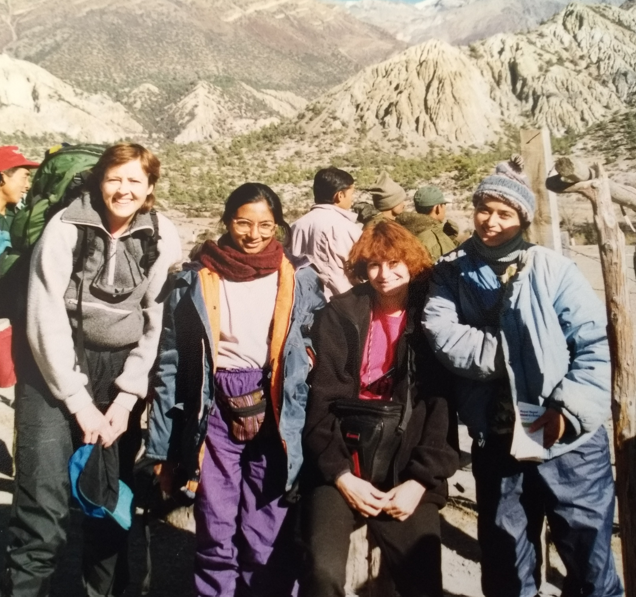
There were fond farewells as we all packed up. Jyoti and Baishali would catch their plane to Pokhara straight after breakfast. They had been good travelling companions for the past few days. It’s strange how you get to know people better in a few days’ travelling than you do other more sedentary folk in years back home. I guess that fellow adventurers in the wilderness must already have a lot in common. It always feels sad to part from new friends. Eva felt quite upset and even threatened to cry a little. The fond farewells were wasted anyway since our four-person team set off along the trail some ten minutes later and had gone only a few hundred metres when Eugene discovered that he had left his underpants on the washing line at the Maya Lodge. As he rushed to retrieve them the tiny Nepal Airlines plane came buzzing out of the sky to land on the nearby airfield. Beth and I simultaneously had the same idea.
‘Hey. We could go and watch it and see the girls off.’
Beth plonked her bag down and we left Narayan on guard while we hurtled off across the rock, dried mud and scrub towards the airfield. Most of the villagers were already there and those who weren’t joined us in the rush. Obviously, the twice weekly plane from Pokhara was one of Ongre’s leading events. Even the dogs were all racing around yapping and trying to bonk each other. Quite a crowd of passengers were waiting to board. We spotted mad Madhu and his sickly Finnish friend among them. Jyoti and Baishali were sitting on the fence next to an antiquated luggage weighing contraption which looked like something out of a Greek meat market fifteen years ago.
‘Hello. Hello again,’ we called. ‘We’ve come to see you off.’
We had time for more photos and to exchange addresses before Eugene came along, reunited with his underpants. I was really glad that their temporary displacement had enabled us to see the plane. Taking off and landing on Ongre’s tiny airstrip was not for the fainthearted. Dramatic mountains fringed by castles of wind-eroded rock rose jaggedly all around. The passengers finally made their way up the few steps and disappeared through the door only to wave again from a porthole a few seconds later. Then the little propeller plane beetled along the airstrip, turned around, gathered speed purposefully and buzzed off into the air like a child’s remote-control toy. It headed for the narrow gap between the mountains and soon was a white speck whirring in the distance.
Feeling elated, we strolled back to the path, avoiding all the dogs who were still trying to gang bang a poor bitch, who I recognised as our golden follower of the previous day. Sensibly, she decided to escape her squabbling admirers and follow us again. Narayan was waiting patiently with the backpacks chewing his tobacco gum. The sun was already growing warm. How good it felt to be walking through sun dappled forest at over 3,000 metres enjoying some of the best views on the planet! Eugene and I walked ahead again marvelling at everything and voicing concern about the high pass that lay ahead. We were nearing our goal now. Would we or wouldn’t we succumb to the dreaded altitude sickness? Only a combination of luck and good sense would help us. As we bounded on upwards we met a suntanned blonde woman coming the other way. She looked far too healthy to have turned back with mountain sickness so we assumed that she had come over the pass in clockwise direction, the opposite to ours, so we asked her what lay ahead. It turned out that she was one of the volunteer doctors at the Himalayan Rescue Association in Manang.
‘Do you think we look healthy enough to go over the pass?’ Eugene asked brightly.
‘Oh yes,’ she said. ‘You two should have no problems.’
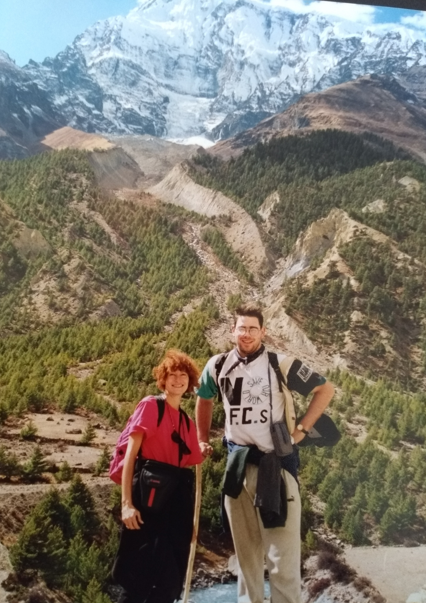
This was cheering. I added that if loss of appetite was a symptom of altitude sickness, then I certainly hadn’t got it yet. I was relieved that Manang and food lay only an hour’s walk away.
The sun disappeared at about 10.00am and a cold wind sprang up. Somehow bleaker light seemed more appropriate in the semi-arid Tibetan landscape that now replaced the forest. Chortens and mani walls marked the entrance to the village of Bryaga. The gompa on the hill was supposed to be a popular side trip on rest days in Manang. We were now walking on a dry, dusty track high above a river which meandered across a brown and fawn plain to our left. To our right was the hill with the gompa and a series of flat-topped houses with a sea of pray flags. Beyond the plain rose the brown and white bulk of the Annapurnas. We stopped to take photos of some etchings on a mani wall and a little girl in rags ran up. Eugene asked to take her photo and she instantly stretched out her hand. I find it sad that virtually all Nepali children seem to equate foreigners with instant handouts in a way that their parents would find utterly demeaning. I wonder what sort of adults they will become.
We put our fleeces back on as we crossed the last part of the plain. We could see the white entrance chorten of Manang in the nearing distance. I felt we had already achieved quite a lot as we walked beneath the stone gate carved with dragons sporting a sign declaring ‘Welcome to Manang Village’ and lots of others advertising the usual ‘luxuries’ of the local hotels. According to Eugene’s guide book we had walked 96km and gained 2,745m in height. This was a half-way point. Ahead of us lay the most difficult few days and after that it would be downhill all the way (well, nearly!) Here in Manang there would be a chance to rest, hopefully get clean and, most important of all, reassemble the core gang of lovely people we had met so far to experience the Thorong La pass together.
There were lots of hotels in the village. We met Dutch Paul outside the Yak Hotel and, on his recommendation, decided to make our base there. It was larger than our usual favoured guest houses but at least the walls looked solid and, at this height with a cold gale blowing, we had to consider such things. Tony, Eva and Claudia were staying there so it promised to be fun and there was plenty of room for any of the gang who had started from Pisang that morning if they turned up later in the day. Beth Eugene and I were allotted a large three-bedded room which actually boasted electricity for most of the day. The main disadvantage of the Yak Hotel was that it had the first mirror we had seen for days. It was a dirty, cracked old thing hanging at a slant from the balcony railing so you had to pass it to go to the dining room. Catching a glimpse of their unwashed, uncombed selves after a week on the road came as a shock to most people. One of the advantages of living in the wilds with no mirror is that one cannot see how awful one is looking. Your friends’ appearance deteriorates so gradually that you don’t really notice, but when you last saw yourself looking fairly human and are suddenly confronted by a ‘creature’ in the glass, you wonder why no-one else has said anything! Eugene’s stubble was less ‘designer’ than he had imagined. I looked like an over-exposed photo and, disturbingly, my hair had changed colour. It is normally dark brown but the strong high-altitude sun had turned it into a frizzy reddish mess. It was greasy, covered in dust and stuck out like a haystack. All this made me feel quite depressed. Suddenly aware of my ghostly pale face, Eva and Claudia asked if I still intended to go over the pass. This made me (a born hypochondriac) feel that maybe I was ill after all. I was struck by the fear that the doctors at the HRA would take one look at me and pronounce that I was unfit to go any further. Ironically, though I looked sicker than anyone, I probably felt better than most and settled down to demolish a huge bowl of noodle soup and several gallons of tea. All this warming liquid brought a little colour back to my face. I decided it must have been the cold that had sapped it.
I have always loathed and feared the cold and it now became my biggest obstacle to getting over that damn pass. We met a girl yesterday who had turned back because of the cold. It was already making me miserable in Manang and I still had 2,000 vertical metres to go.
We were to attend the daily lecture on the perils of altitude sickness at the HRA at 3.00pm. In the early afternoon Eugene and I climbed up to a ridge just behind the village. We were bundled up like Michelin men in our down jackets. We sat braced against the wind and stared down at the desolate landscape feeling like the first people in the world. Eugene complained of a slight headache. We knew that you were supposed to sleep lower than the highest point reached during the day. We were about 30m above the village. That would have to do!
We met Beth at the lecture and Rob and Clare also turned up, hardly recognisable in all their Michelin men gear. Clare looked red-nosed and waxen-cheeked like me. We all decided to be the ‘back seat yobos’ partly because the back seat was against a wall and offered some protection from the wind. There were many familiar faces and some new ones in the auditorium. I thought how a new generation of trekkers must sit bundled up and shivering in a mixture of anticipation and fright every day on these same seats. Everyone laughed at morbid tales and called out to friends until the volunteer doctor/speaker appeared and silence fell. He could not have had a more willing audience. Recognising the symptoms of acute mountain sickness could literally be a matter of life or death. We were all terrified by the lecture and most people who had been feeling perfectly well before instantly developed half a dozen psychosomatic symptoms. The doctor tried to assure us that most of the slightly alarming phenomena we may have experienced were perfectly normal signs of the human body adjusting to life at high altitude. These included coughing, poor sleep and weird dreams.
‘Some people report having dreams they haven’t had since they were thirteen years old,’ he told us to a chorus of titters. ‘Of course, none of you are exactly sleeping in the most comfortable conditions, and you are probably disturbed by your own and your room-mates nocturnal voiding.’ (Getting up to have a pee!).
The doctor went on to produce a chart showing the early symptoms of real mountain sickness and their progression towards seriously alarming stuff. There was HACE or high-altitude cerebral edema, characterised by severe headaches leading to eventual coma and death. Then there was HAPE (high-altitude pulmonary edema) characterised by loss of breath, coughing up frothy sputum and blood leading to death. As if that wasn’t enough to worry about, there was also HAFE or high-altitude farting edema, characterising by excessive farting resulting in loss of friends. (The higher you go, the windier it gets – but at least this raised a laugh from the rows of anxious faces). Our doctor also warned women trekkers that taking the pill at extreme altitude carried an increased risk of thrombosis. Instant panic in the ranks.
‘Clare, are you on the pill?’ I hissed.
She nodded in the affirmative and looked paler still.
Dr Doom advised us all to stop taking the pill between Manang and Jomsom and reminded us that extra precautions would be needed during that time. Clare muttered that when you were both bundled up in six layers of sweaters, smelly three-day-old bed socks and balaclava hats, huddled in your sleeping bags on a hard plank bench in a freezing dingy room shared with two strangers, one who coughed all night and the other who farted all night, such precautions were hardly necessary!
A panic-stricken question and answer session followed the lecture. I was worried about the cold and everyone who had had a headache in the past week was worried that it might be altitude sickness. Partly reassured, we all squeezed into the HRA office to purchase T-shirts, tampons and anti-altitude sickness pills called Diamox. Since I had none of the symptoms, I decided not to take the latter but Eugene, nervous about his headache, swallowed one, just in case.
Back at the Yak, I was standing chatting to Claudia in the courtyard when I heard a big scream and turned to see Gerard bounding down the steps from the balcony. I leapt across with a shriek of joy and my legs landed round his waist. Gudrun followed close behind and Eugene heard the commotion and came to join in. How good it was to see them again! We really bonded on the roof of the bus and I thought we had lost them way back. It now looks as though we’ll be tackling the pass with some of the favourite people I’ve met so far and who felt just as wimpy as I did about it.
I joined the queue for a shower. No screams came from within so it seemed as if it might actually be hot for once. An American girl called Terry was in front of me so we minded each other’s trainers and down jackets in turn. The shower was a tap at waist height, but it was hot. I stripped down shivering and sat on the floor under it. This was the first proper wash I had had since we left Kathmandu. I even managed to wash my revolting hair properly. By the time I’d finished the bathroom was all steamy.
I located Eugene drinking tea in the dining room with Tony, Claudia, Eva, Paul, Irena, British John, Alison and several unknowns. The atmosphere was hectic and raucous. The room was bursting to the seams with all the hotel guests and a whole tribe of campers from a nearby field who had decided that cold beer and a warm room were better than their tents. Sulum, the Austrian trio’s guide was among the crowd, but Narayan had discovered that he had left his purse at the Maya Lodge in Ongre while I was queuing for the shower and had run back to fetch it with their porter as a companion. Beth emerged from her usual furrowing in her backpack and joined us for the inevitable bowl of boiling water. I ordered momos. With hot food, tea and a crush of bodies the room became quite warm. The two kitchen boys pushed through the crowds wielding pots of tea and plates of potatoes. It took ages to get served but, considering the circumstances, I think it was a miracle that a hundred or so hungry trekkers should get served with anything like the food they had ordered. We had to say fond farewells to most of our table companions of the evening. Beth, Eugene and I, being sensible scaredy-cats, will stay on in Manang tomorrow to rest and acclimatise. Most people do this. As well as being sensible, Manang is a pleasant place to hang out with lots of interesting side-trip possibilities. However, the Austrians are pushed for time and plan to go all the way to Thorong Phedi tomorrow then cross the pass the next day. They are experienced mountaineers and confident that they can do it. Dutch Paul is also confident that he can get over Thorong La in two days. Irena is less so. She has hired a porter to carry her backpack as far as Muktinath on the other side but she is still worried that she will not be able to keep up with Paul. If she can’t, he’ll just have to wait since it’s dangerous to cross the pass alone. We all exchanged addresses and I arranged to meet Paul and Irena in Pokhara. They should be there at the same time as us and I’ll be glad to see them again. Not only are they great people, but since Irena’s English is virtually non-existent, my Spanish is in a healthier state than it’s been for years.